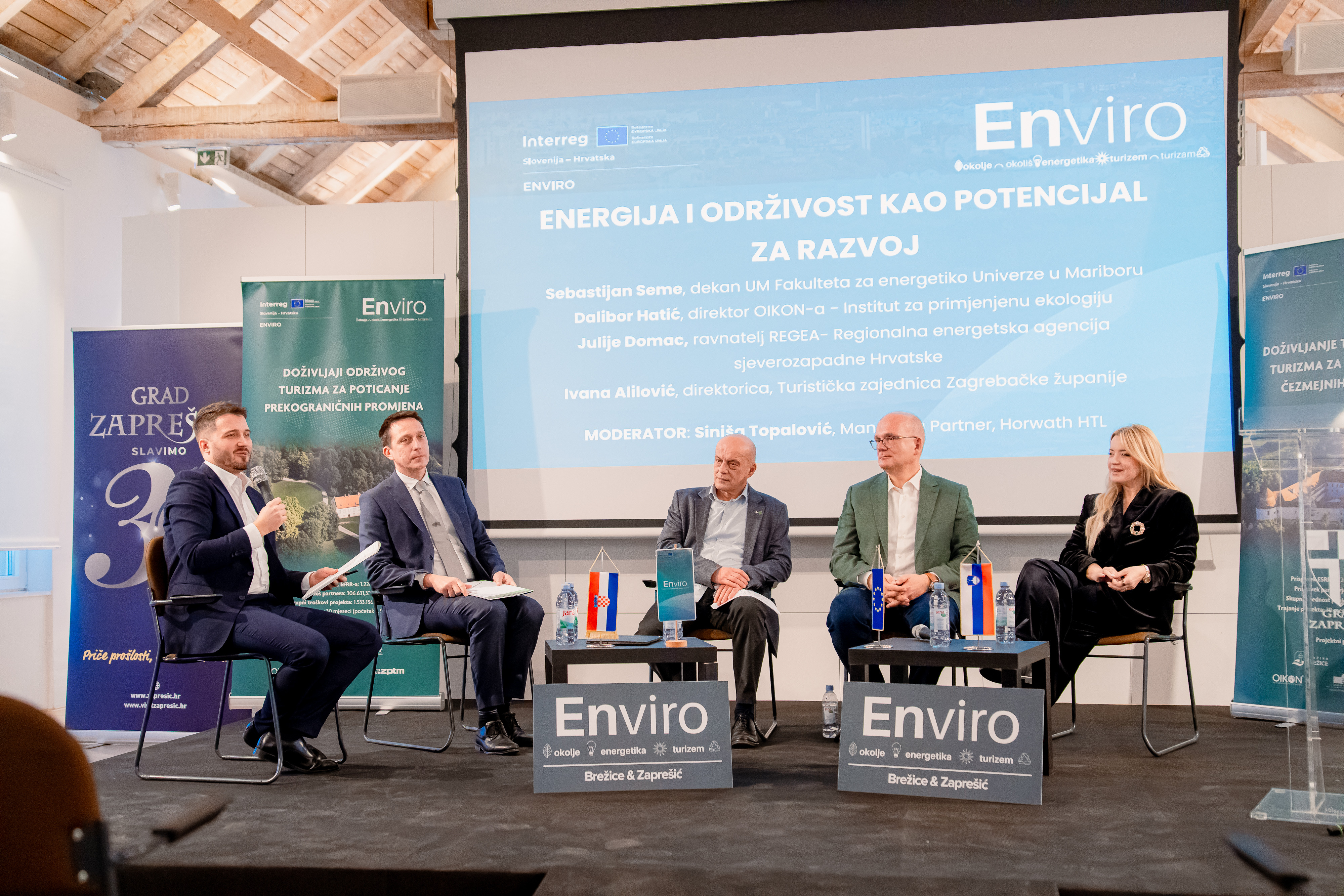
The cross-border conference “Bridge of Energy – Zaprešić & Brežice” held in Zaprešić brought together representatives of national and local authorities, experts in the fields of energy and tourism, as well as members of the academic and business communities from Croatia and Slovenia.
Participants agreed that sustainability and energy are no longer a choice, but a prerequisite for development, while accessibility is not an added value, but a quality standard of a destination.
Through presentations, expert discussions, and the presentation of the ENVIRO project, it was confirmed that the green transition, energy efficiency, and smart resource management are becoming the foundation of long-term competitiveness. Zaprešić and Brežice were highlighted as examples of small destinations which, unburdened by mass tourism, have the opportunity to build their development in a planned, sustainable, and inclusive way.
The conference was officially opened with welcome addresses by Željko Turk, Mayor of the City of Zaprešić, and Ivan Molan, Mayor of the Municipality of Brežice, who emphasized the importance of cross-border cooperation as a foundation for regional resilience and long-term development.
On behalf of national institutions, participants were addressed by Monika Udovičić, State Secretary at the Ministry of Tourism and Sport of the Republic of Croatia, and Domagoj Mikulić, State Secretary at the Ministry of Regional Development and EU Funds of the Republic of Croatia.
State Secretary Monika Udovičić stressed that sustainable tourism is not a trend but a strategic choice for Croatia. Investments in the green and digital transition, energy-efficient solutions, and accessibility represent the foundation of long-term competitiveness. She especially emphasized the social dimension of sustainability, noting that accessible tourism means creating equal and dignified experiences for everyone, while also representing a development and business opportunity. In this context, a new public call “Tourism for All,” worth €7 million, was announced.
State Secretary Domagoj Mikulić stated that the ENVIRO project demonstrates how EU funds can be used strategically and concretely — for projects that leave a long-term developmental impact. The goal, he said, is not only to absorb funds, but to direct them toward initiatives that strengthen regional cooperation, competitiveness, and quality of life. Such cross-border projects confirm the purpose of the European Union’s cohesion policy.
The Ministry of the Economy, Tourism and Sport of the Republic of Slovenia also welcomed the ENVIRO project as an excellent example of cross-border cooperation in tourism. Slovenia and Croatia have been successfully cooperating for many years at both regional and national levels, as tourism connects people, builds bridges, and strengthens intercultural dialogue. “The ENVIRO project demonstrates that sustainability, environmental protection, renewable energy sources, and accessibility can be combined into an attractive and competitive tourism product. We believe that this cross-border destination, with its quality offer, sustainable mobility, and experiences, will impress many visitors,” emphasized Jasna Radić from the Ministry of the Economy, Tourism and Sport of the Republic of Slovenia.
ENVIRO – concrete results of cooperation
The central part of the conference was dedicated to the cross-border project ENVIRO, presented as a successful example of cooperation between Zaprešić and Brežice.
Mayor of Zaprešić Željko Turk emphasized that the project confirms how tourism development must go hand in hand with environmental protection and the use of renewable energy sources, highlighting its role in the strategy of developing Zaprešić as a green and sustainable city. He particularly pointed out that the project contributes to the valorization of the Novi dvori of Ban Jelačić estate and the creation of high-quality visitor experiences.
Mayor of the Municipality of Brežice Ivan Molan stated: “I am pleased that the ENVIRO project is already delivering concrete results. For Brežice, such cross-border projects represent an important development opportunity, as they encourage tourism and strengthen cooperation with partners across the border. Through pilot testing of an accessible tourism product, we have shown that we can create joint solutions and that accessibility is becoming a standard of modern tourism supply. I am convinced that ENVIRO will significantly contribute to the further development of sustainable and inclusive tourism in our region.”
The project was presented by Matejka Gerjevič, Head of the Department for Social Activities, Economy, Agriculture and Development of the Municipality of Brežice, and Jasminka Varupa Krajnik, Head of the Department for Investments and EU Funds of the City of Zaprešić.
“ENVIRO is not only an infrastructure project, but a development platform connecting energy, tourism, and local development into a unified green transition strategy. The total project value amounts to €1,533,156.79, of which 80% is co-financed through the Interreg Slovenia–Croatia programme from the European Regional Development Fund, while the remaining share is provided by the project partners.”
Energy, development and inclusion – three pillars of competitiveness
The expert part of the programme included a lecture by Siniša Topalović, Managing Partner at Horwath HTL, who emphasized that cities and destinations can no longer be mere administrators but must become drivers of development. As he noted, investors do not invest in visions, but in credibly prepared projects with clear business models.
The panel discussion “Energy and sustainability as development potential” featured Sebastijan Seme, Dean of the Faculty of Energy Technology Brežice, Dalibor Hatić, Director of OIKON, Julije Domac, Director of REGEA, and Ivana Alilović, Director of the Zagreb County Tourist Board. The panel concluded that technology enables sustainability, but governance determines whether it will actually be realized. A sustainable destination exists only when technology, the environment, and residents’ quality of life are in balance.
A good practice example was presented by Rudi Grula, Director of the Međimurje Tourist Board, who emphasized the importance of strategic and long-term management of inland destinations.
The panel “Accessibility as a standard, not an exception in tourism” featured Damir Krešić, Director of the Institute for Tourism, Alenka Mokrovič Pogačar, Head of Marketing and Sales at Terme Čatež, Slaven Škrobot, well-known traveler, and Ivana Kolar, Director of Julius Rose and TOURISM 365. The discussion highlighted that inclusivity is not a social category but a measure of destination maturity. Accessibility begins with empathy but ends with strategy — when it becomes part of product design rather than an afterthought.
The conference concluded with the presentation of the cross-border tourism product “Bridge of Energy,” introduced by Damjan Radanovič, Project Manager at ZPTM Brežice.
The final message of the meeting can be summarized simply: the destinations of the future will be those that manage to be green, smart, and inclusive at the same time — and thanks to the ENVIRO project, Brežice and Zaprešić are certainly on that path.